What Multi‑Agent Orchestration Changes for Teams Shipping with Coding Agents
A practical look at using a strong "manager" model to coordinate a swarm of cheaper coding agents, and what that actually changes for engineering teams.
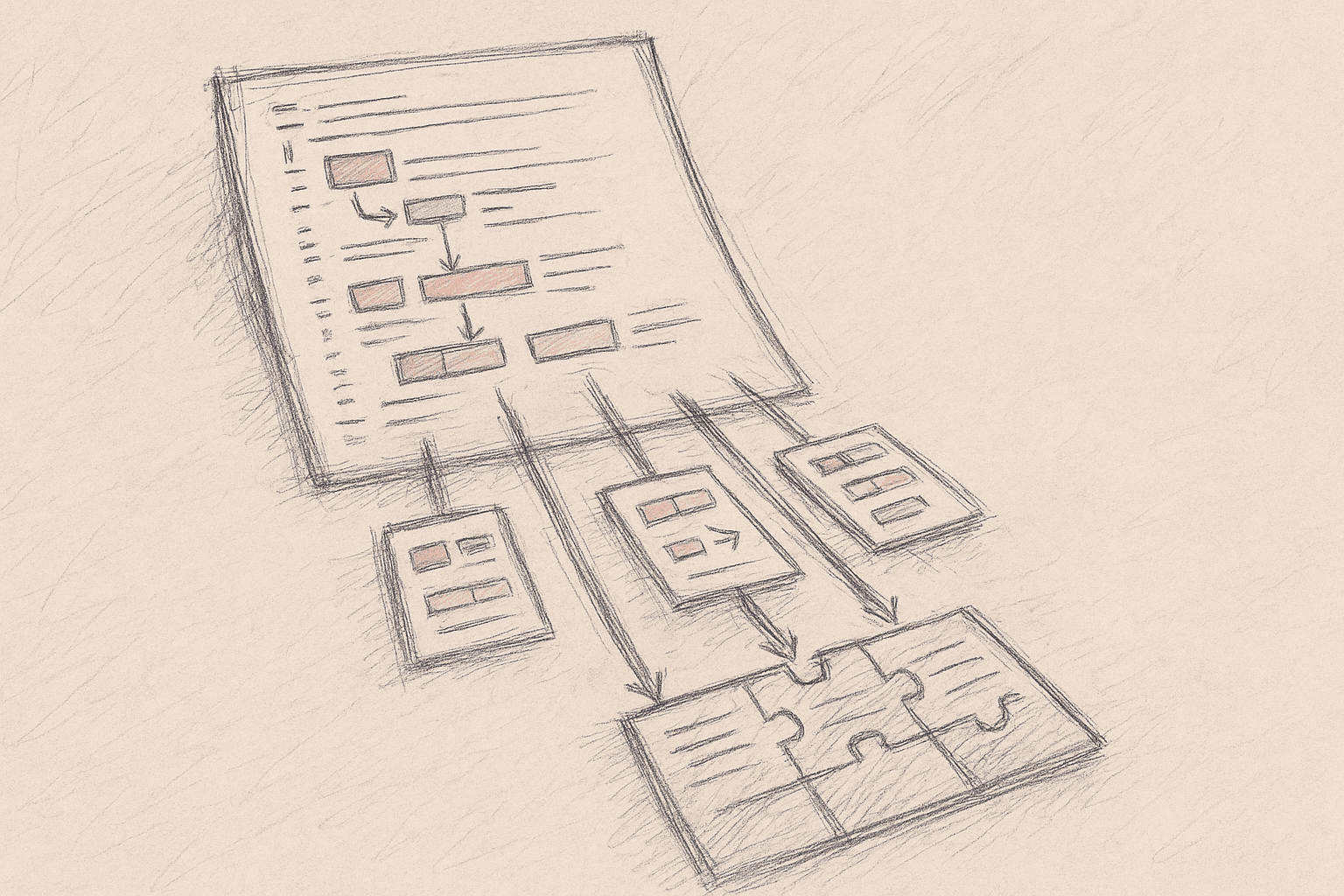
The pattern behind “a strong model manages cheaper coding agents” is straightforward:
- A capable model plans and reviews.
- Several smaller models do bounded edits.
If you already use a single agent, orchestration is less about raw speed and more about how work gets sliced, reviewed, and merged. The focus here is on practical changes and the failure modes you should expect.
From single agent to orchestrated swarm
A single coding agent today usually does one of three things:
- Inline edits in your editor.
- One‑shot generation of a file or function.
- A linear “plan → implement → test” loop.
Multi‑agent orchestration adds two extra layers:
- Task decomposition – a manager model breaks a goal into smaller coding tasks.
- Parallel execution and review – worker agents implement tasks while the manager coordinates and reviews.
In practice, this changes:
- Granularity of work: from “implement feature X” to “update schema”, “add endpoint”, “adjust client”, “write tests”.
- Concurrency: more work can happen at once, especially on large refactors or multi‑service changes.
- Failure modes: instead of one big wrong change, you get many small ones that may conflict or drift.
The value comes from better structure and review, not just more tokens.
A concrete orchestration pattern
You can implement a basic “Opus‑as‑manager, Codex‑as‑workers” setup with three roles:
- Manager (Opus 4.6 in the thought experiment): plans, assigns tasks, integrates results.
- Worker (Codex 5.3): writes or edits code for a specific, bounded task.
- Verifier (can be the manager, a separate model, or tests): checks outputs.
-
Goal intake — human describes the change and points to relevant files or modules.
-
Planning (manager) — reads the goal and a project summary, proposes a task list with clear boundaries, and marks which tasks can run in parallel.
-
Dispatch (orchestrator code) — turns each task into a worker prompt that includes current snippets, constraints, and the required output format (patch, file, or function).
-
Execution (workers) — produce scoped patches plus a brief rationale and assumptions when helpful.
-
Verification (tests + model) — run fast checks; let the manager compare patches to the plan and flag inconsistencies.
-
Integration (manager + human) — manager proposes merge order; human reviews consolidated diffs; orchestrator applies patches and re‑runs the full suite.
Where this helps most
Multi‑agent orchestration is not uniformly useful. It tends to pay off in a few specific scenarios.
Large, mechanical changes
Examples:
- Updating an API signature across many call sites.
- Migrating a logging or metrics library.
- Applying a consistent linting or error‑handling pattern.
The manager can map all affected files, create one task per module, and let workers apply the same change in parallel. Tests and review still gate the merge, but the search‑and‑edit work is offloaded.
Multi‑service or multi‑layer features
Features that touch backend, frontend, and shared contracts often stall on sequencing: schema, handlers, SDK, UI. A manager can lay out dependencies, run independent tasks in parallel, and keep a single view of the change while workers stay local. This mostly lowers the “forgot to update X” bug rate.
Continuous refactoring and hygiene
Run a low‑priority loop that scans for duplication, opens small refactor tasks, and lets workers propose patches for the manager to triage. It behaves like a junior cleanup crew with a lead keeping score.
Practical implementation steps
Step 1: Make the codebase legible
Orchestration fails if the manager cannot form a rough mental model.
- Maintain a short architecture summary (services, key modules, data flows).
- Keep a symbol index you can feed into prompts (classes, functions, endpoints).
- Standardize project metadata: language versions, frameworks, test commands.
Step 2: Start with manager‑only planning
Use the strong model only as planner first. Give it a feature request and project summary; ask for a task breakdown, file list, risks, and open questions. Humans still code, which helps you calibrate granularity and surface gaps in the model’s understanding.
Step 3: Add workers for low‑risk tasks
Route only low‑risk items to workers: comment improvements, tests for existing behavior, small refactors with coverage. Keep constraints tight: workers may only touch specified files, must return patches, and every patch goes through tests and human review.
Step 4: Introduce manager review
Let the manager review worker patches before humans: reject off‑plan changes, request fixes, and summarize the change set. This filters out noisy diffs.
Step 5: Expand scope carefully
Once tests, plans, and worker quality are reliable, allow agents into riskier areas, but keep humans as the final gate for core logic and security‑sensitive code.
Tradeoffs and limitations
Multi‑agent orchestration carries costs and new failure modes.
Coordination overhead
- You need an orchestration layer to manage tasks, prompts, and patches.
- Logging matters: you should be able to answer “who changed what, based on which instruction?”
Context and token limits
- The manager needs enough context to plan and review. Summaries and symbol indexes help, but you still hit window limits on large monorepos.
- Feeding entire files to workers is expensive; prefer minimal snippets plus constraints.
Conflicts and ownership
- Parallel patches can conflict or drift. Keep tasks scoped to files or modules, and have the manager propose a merge order.
- Make ownership rules explicit so agents do not rewrite critical files unchecked.
Testing and safeguards
- Orchestration amplifies whatever test coverage you have. Weak suites mean faster bad merges.
- Run static checks and fast tests per patch; keep a full suite gate before merge.
When to hold off
Skip orchestration if your codebase is still in rapid architectural flux, if test coverage is thin, or if you lack bandwidth to monitor logs and review patches. A single strong agent with human review is simpler until those foundations solidify.
Bottom line
Orchestration changes coding work from a single linear chat to a set of coordinated micro‑tasks with an explicit planner and reviewer. The gains show up as better structure, fewer missed steps, and faster mechanical edits, provided you invest in context, tests, and basic tooling to keep the swarm pointed at the same target.
Want to learn more about Cursor?
We offer enterprise training and workshops to help your team become more productive with AI-assisted development.
Contact Us