Multiple Cursor Agents for One Task
Four parallel Cursor agents cost four agent runs, and a model judge adds another model call. Cursor can send one prompt to several agents at once by creating a separate worktree per agent, then you review the outputs and choose what to keep.
That was our July 2026 Cursor workshop answer in plain terms: useful sometimes, poor as a default. For an accuracy check, two agents on strong models are usually enough. A person still has to own the final decision, because letting one model keep changing another model’s work can turn into an open loop.
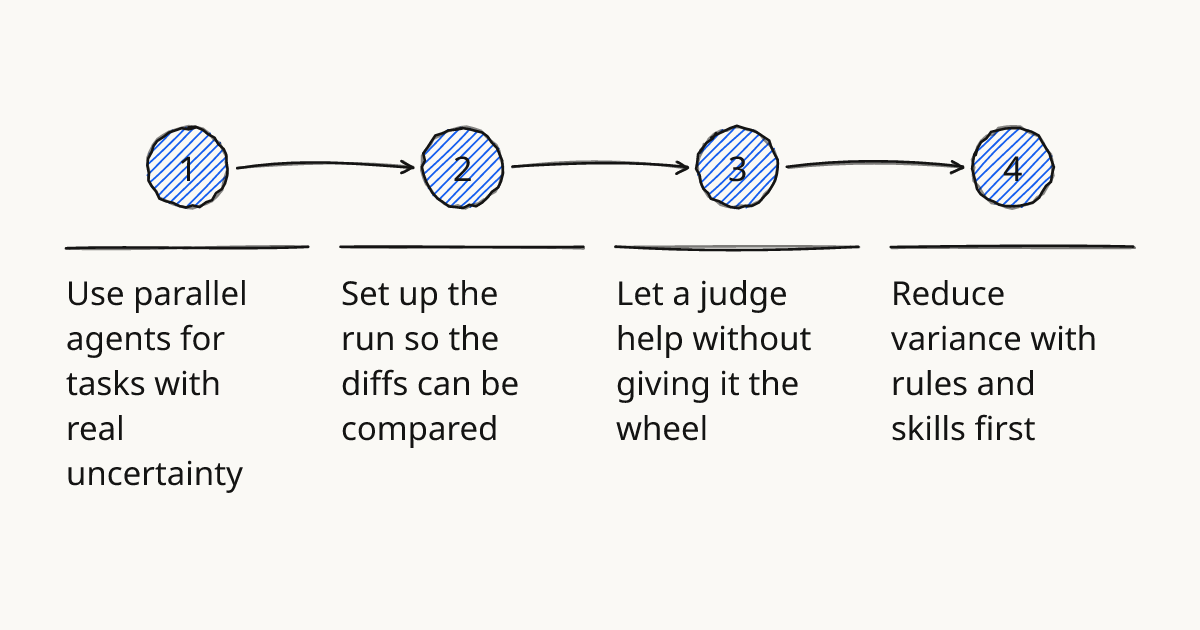
Use parallel agents for tasks with real uncertainty
A best-of-n run pays off when the task has more than one plausible design. It can help on a refactor with several safe paths, a bug where the failure mode is unclear, or a change where one agent may miss a constraint.
It adds little when the task is mechanical. If the instruction is to rename a prop or update a copy string, multiple Cursor agents will mostly create review work.
The phrase “run one task through several Cursor agents and keep the best result” should be handled as a review question. The question is whether the extra attempts make the final patch easier to trust.
For related cost planning, see Cursor Agent Usage Limits for Teams. For the broader feature family, keep Subagents and skills nearby.
Rolling this out in your team?
We train engineering teams on their own codebase in two days. Cursor setup, shared rules and review included.
Set up the run so the diffs can be compared
Give each agent the same starting prompt and the same acceptance criteria. Cursor’s separate worktrees matter because they let you compare independent outputs without mixing partial changes.
Keep the prompt short enough that the agents have room to reason. Put durable repo guidance in Cursor rules or a Cursor skill when it should apply beyond this one task.
A concrete workflow is simple: ask two agents to fix the same failing behavior, inspect both diffs, run the same verification on each worktree, then merge the patch you can explain. More agents raise cost and review time quickly.
Let a judge help without giving it the wheel
A judge model can summarize differences between two outputs. It can point out missing tests, risky edits, or places where one patch changes more code than necessary.
The judge should not keep rewriting both answers until it is satisfied. That pattern can create a loop of edits where every model finds a new concern and the code keeps moving.
This belongs in the Review step of our methodology: the model can help compare evidence, but the human reviewer decides what ships. The decision should rest on the diff and the verification result.
Reduce variance with rules and skills first
Cursor rules are the better place for repository constraints that every agent should follow. Use them for conventions that should survive across prompts.
Cursor skills are useful when the agent needs a repeatable workflow or reference material. A Cursor skill can make each agent start from the same process, which often improves the first run more than adding extra agents.
Cursor subagents and custom agents are stronger once the work has a clear role boundary. For example, one custom agent can focus on implementation while another focuses on review, but the handoff still needs a human decision point.
Copyable decision table for best-of-n runs
Copy this table into the task note before starting a parallel Cursor run. Fill it out before choosing a winner.
| Decision | Use two Cursor agents | Use four Cursor agents plus judge | Skip parallel agents |
|---|---|---|---|
| Task shape | Ambiguous bug, risky refactor, unclear implementation path | High-value change where independent solutions may expose hidden risk | Mechanical edit or small scoped change |
| Cost | About two agent runs | Four agent runs plus the judge model call | One normal agent run |
| Review load | Compare two diffs and run the same checks | Compare several worktrees, then review the judge summary | Review one patch |
| Best signal | One patch is smaller, safer, or better verified | The judge helps surface differences the reviewer may miss | The single patch passes the agreed check |
| Stop condition | A human can explain why one patch wins | A human accepts one patch after verification | The patch meets the task criteria |
Further reading
Next step
For the next risky Cursor change, run two agents and compare their diffs before merging. If you want to practise that review loop, use our hands-on training on Cursor agent workflows.
Related research
Train your team on Cursor
Two days on your team's own repository, onsite or remote, with a written proposal before you commit.
Book a callPrefer to measure first? Take the free team check.