Cursor Agent Usage Limits for Teams
As of November 2026, Cursor’s public docs describe the agent workflow and the customization surfaces around it: rules, skills, subagents, hooks, MCP and cloud agents. They do not give your repository a safe default operating policy. A working team needs its own convention for what an agent may change before a human checks the work, with the task boundary and the review boundary set before the agent starts.
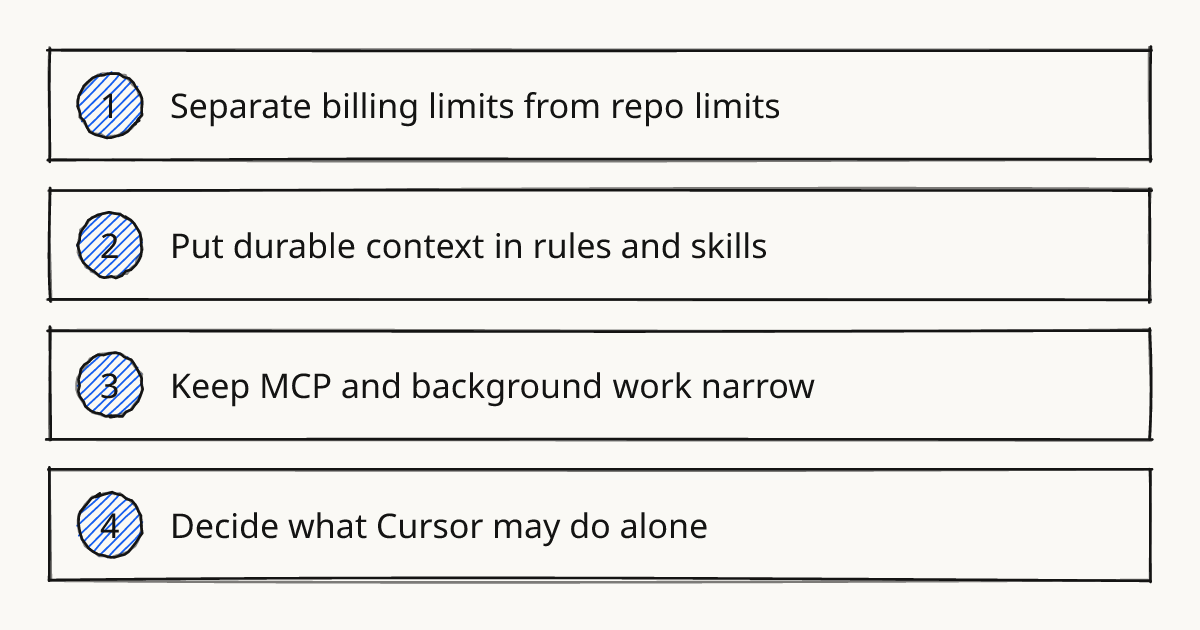
Separate billing limits from repo limits
Plan quotas and admin settings decide how much Cursor agent usage the team can spend. Repo conventions decide what a Cursor agent may do with that usage.
The engineering work is to turn the product limit into a team workflow limit. Plan numbers can change, so they stay out of repo files. The repo file says which work is safe, which work needs approval and which work is never delegated.
Rolling this out in your team?
We train engineering teams on their own codebase in two days. Cursor setup, shared rules and review included.
Put durable context in rules and skills
Use Cursor rules for constraints that should apply every time, such as protected paths and security review triggers. Use Cursor skills for repeatable work that needs its own instructions or scripts.
A concrete workflow: in a Next.js service repo, let a skill carry the release-note template and verification commands, while a rule says the agent must not change auth middleware or billing code without a named reviewer. The agent gets useful context without turning every prompt into a wall of policy.
Cursor subagents and Cursor custom agents are useful when the role is narrow. A review subagent can inspect a diff against repo rules. A docs subagent can update usage examples after an API change. Keep Subagents and skills close to the repo conventions, and use Use Cursor Skills in Team Repos when you need a deeper skills pattern.
Keep MCP and background work narrow
Give MCP access the same treatment you give production credentials: start read-only, name the server and say which tasks may use it. A Cursor agent with access to GitHub issues or internal project data can save time, but broad access makes review harder.
Cursor background agents are valuable for ticket-sized work because they can keep moving while the developer stays in another flow. They also make boundaries more important. A background branch should state the task boundary and anything the agent skipped.
This is the Review step in our methodology: the human owns the decision. The agent can propose and run checks, but the reviewer needs a diff and a clear list of unresolved risks.
Use this repo convention
Paste this into the root AGENTS.md, or adapt it into a .cursor/rules/agent-usage.mdc rule when you want Cursor to load it as repo policy. Keep service-specific exceptions in nested AGENTS.md files or local rule files.
# Cursor agent usage convention

Applies to: this repository and all Cursor agents working against it.

Allowed without approval:
- Read code, docs, tests, and issue context.
- Make changes inside one declared task boundary.
- Add or update tests for the touched code.
- Run documented local checks.

Needs approval before work starts:
- Database migrations or schema changes.
- Authentication, authorization, billing, or data deletion paths.
- New dependencies, MCP server changes, hooks, or generated code committed to the repo.
- Edits across more than one service or package.

Cursor rules:
- The agent must state the task boundary before editing.
- The agent must list files it expects to touch.
- The agent must stop when it needs a secret, production data, or an unlisted tool.

Cursor skills:
- Use repo skills for release notes, test commands, migration checks, and PR descriptions.
- Do not paste long-lived repo rules into a prompt when they belong in a rule or AGENTS.md.

Subagents:
- Use a narrow subagent for review, test repair, or documentation work.
- Do not let one custom agent plan, edit, test, and approve its own diff.

Review receipt:
- PR description includes task boundary, commands run, skipped checks, and files that need human attention.
One engineer proposes this in a normal PR and code owners review it. The final convention lives in the repo, where the whole team can read it.
The review rule is simple enough to enforce: reject agent-created work when the task boundary is missing, protected files changed without approval, checks are not reported, or the agent used a tool the repo convention did not allow.
Decide what Cursor may do alone
Use the table as the first policy pass. It gives the team a shared answer before arguing over individual prompts.
| Cursor surface | Good fit | Limit to write down |
|---|---|---|
| Cursor agent mode | One local code slice with nearby tests | Agent states files it expects to touch before editing |
| Cursor background agents | Ticket-sized branch or draft PR | PR must include commands run, skipped checks, and review risks |
| Cursor skills | Repeated workflow such as release notes, test repair, or PR summaries | Skills are versioned in the repo and reviewed like code |
| Cursor subagents | Narrow roles such as reviewer, docs updater, or test fixer | No subagent approves its own output |
| MCP | External context from issues, docs, repos, or internal systems | Start read-only and require approval for write-capable servers |
The tradeoff is speed versus certainty. Tight limits may slow the first few agent runs, but they make it easier for a team to trust Cursor agents on ordinary work without letting unusual work slip through unnoticed.
Further reading
Put the convention in one repo today
Create the rule file today, run one small Cursor agent task through it, and bring the same convention to hands-on training if you want the team to rehearse it together.
Related research
Train your team on Cursor
Two days on your team's own repository, onsite or remote, with a written proposal before you commit.
Book a callPrefer to measure first? Take the free team check.